Comparison map
Cell Structure and Function Review: relationships and examples
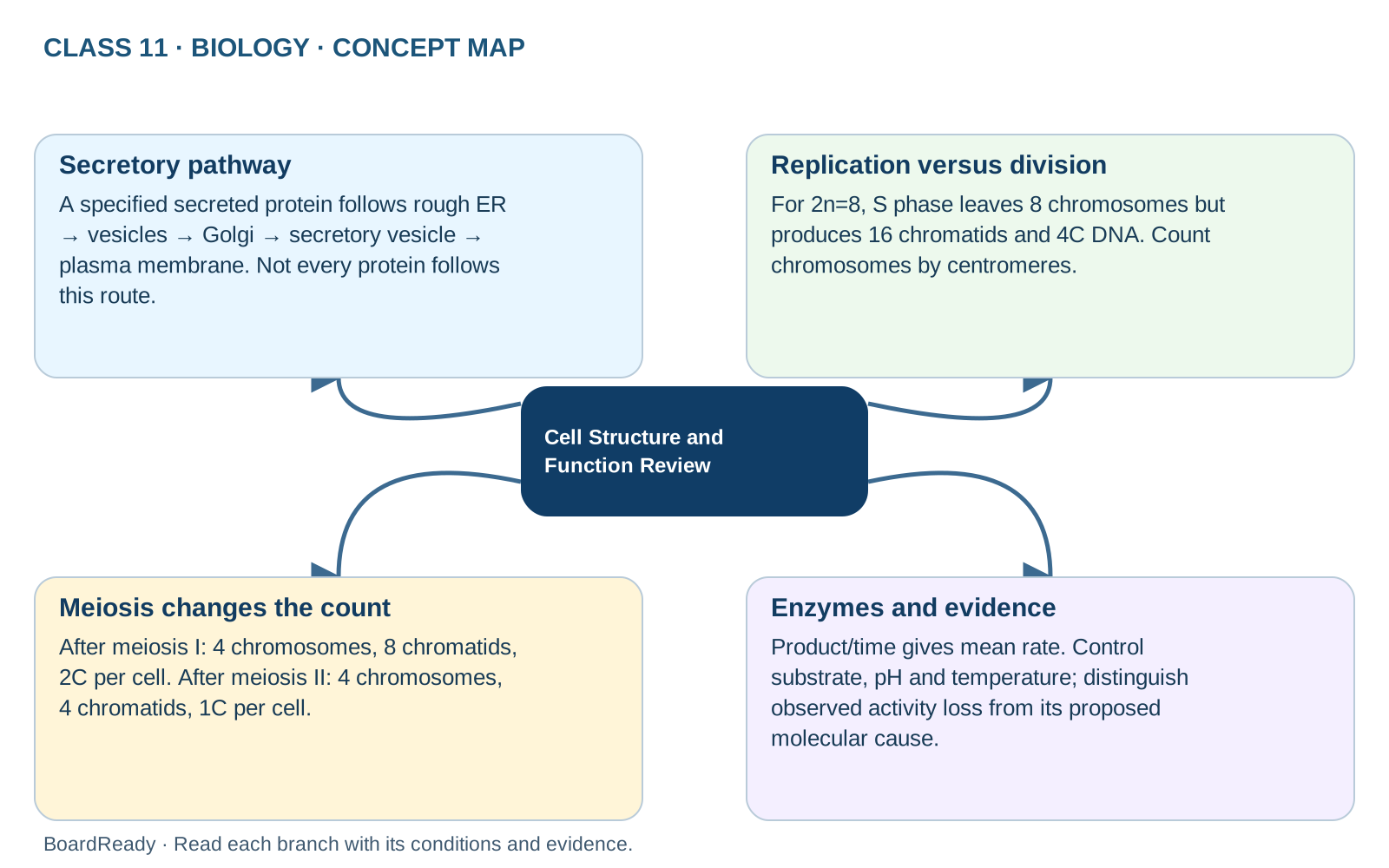
Connect cellular compartments, biomolecules and the changes in DNA during division. State what is counted and which pathway a molecule follows. Secretory pathway: A specified secreted protein follows rough ER → vesicles → Golgi → secretory vesicle → plasma membrane. Not every protein follows this route. Replication versus division: For 2n=8, S phase leaves 8 chromosomes but produces 16 chromatids and 4C DNA. Count chromosomes by centromeres. Meiosis changes the count: After meiosis I: 4 chromosomes, 8 chromatids, 2C per cell. After meiosis II: 4 chromosomes, 4 chromatids, 1C per cell. Enzymes and evidence: Product/time gives mean rate. Control substrate, pH and temperature; distinguish observed activity loss from its proposed molecular cause.Exam cue: Label compartments and direction, or stage and per-cell counts. Support an enzyme interpretation with controls and stated measurements.
- 1Cell Structure and Function Review -> Secretory pathway: A specified secreted protein follows rough ER → vesicles → Golgi → secretory vesicle → plasma membrane. Not every protein follows this route.
- 2Cell Structure and Function Review -> Replication versus division: For 2n=8, S phase leaves 8 chromosomes but produces 16 chromatids and 4C DNA. Count chromosomes by centromeres.
- 3Cell Structure and Function Review -> Meiosis changes the count: After meiosis I: 4 chromosomes, 8 chromatids, 2C per cell. After meiosis II: 4 chromosomes, 4 chromatids, 1C per cell.
- 4Cell Structure and Function Review -> Enzymes and evidence: Product/time gives mean rate. Control substrate, pH and temperature; distinguish observed activity loss from its proposed molecular cause.