Comparison map
Cell: Unit of Life: relationships and examples
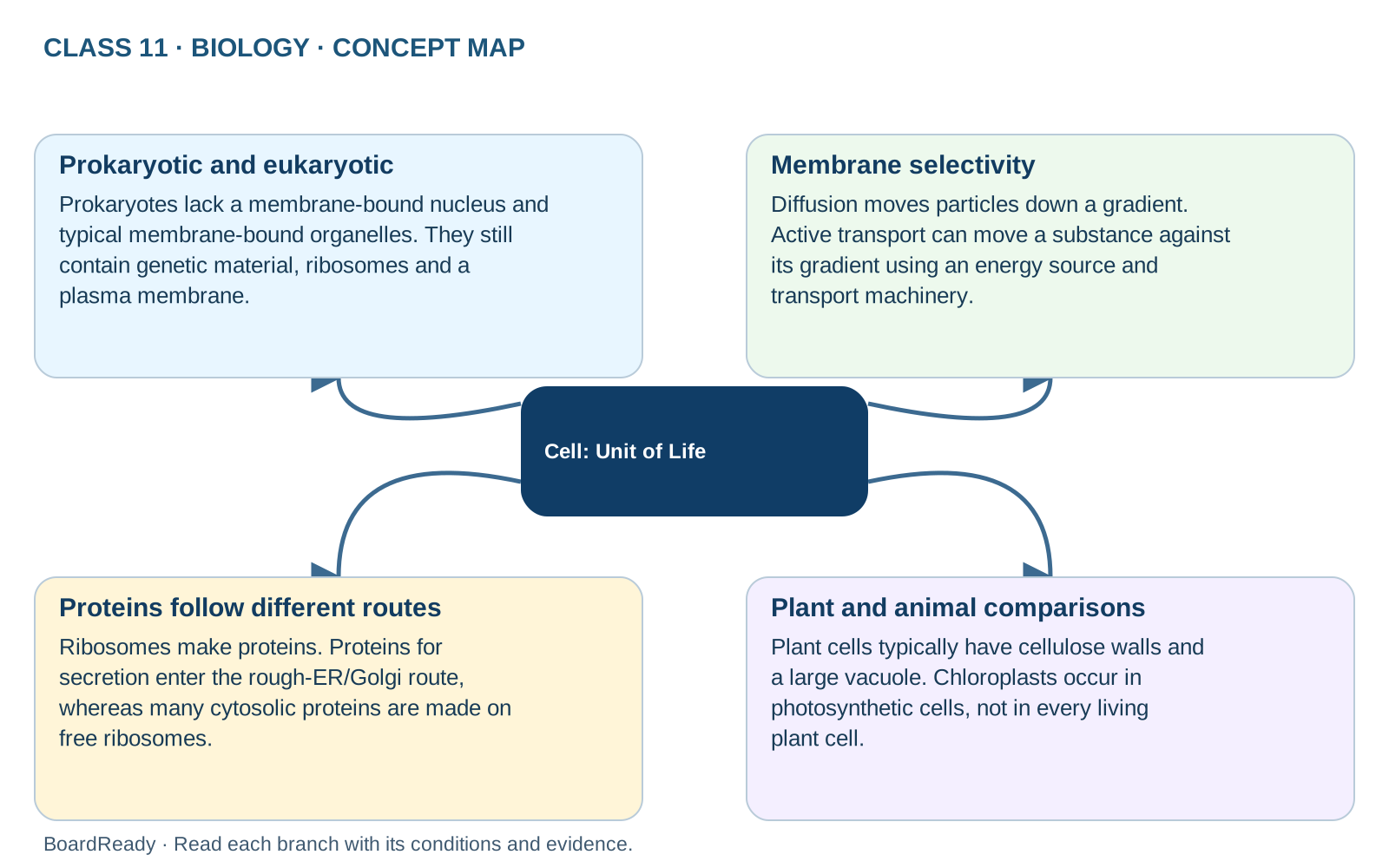
Compare cell types and connect membrane transport with cellular compartments and biosynthesis. Prokaryotic and eukaryotic: Prokaryotes lack a membrane-bound nucleus and typical membrane-bound organelles. They still contain genetic material, ribosomes and a plasma membrane. Membrane selectivity: Diffusion moves particles down a gradient. Active transport can move a substance against its gradient using an energy source and transport machinery. Proteins follow different routes: Ribosomes make proteins. Proteins for secretion enter the rough-ER/Golgi route, whereas many cytosolic proteins are made on free ribosomes. Plant and animal comparisons: Plant cells typically have cellulose walls and a large vacuole. Chloroplasts occur in photosynthetic cells, not in every living plant cell.Exam cue: Compare the same feature in both cell types and avoid treating absence of a nucleus as absence of DNA or protein synthesis.
- 1Cell: Unit of Life -> Prokaryotic and eukaryotic: Prokaryotes lack a membrane-bound nucleus and typical membrane-bound organelles. They still contain genetic material, ribosomes and a plasma membrane.
- 2Cell: Unit of Life -> Membrane selectivity: Diffusion moves particles down a gradient. Active transport can move a substance against its gradient using an energy source and transport machinery.
- 3Cell: Unit of Life -> Proteins follow different routes: Ribosomes make proteins. Proteins for secretion enter the rough-ER/Golgi route, whereas many cytosolic proteins are made on free ribosomes.
- 4Cell: Unit of Life -> Plant and animal comparisons: Plant cells typically have cellulose walls and a large vacuole. Chloroplasts occur in photosynthetic cells, not in every living plant cell.